

Persian Mahal rugs are among the most enduring styles of antique Persian carpet, prized for their spacious floral compositions, warm and versatile color palettes, and durable hand-knotted construction. Woven in villages around Mahallat and Arak (formerly Sultanabad), Iran, these rugs rose to international prominence in the late 19th century and remain a favorite among collectors and interior designers today.
At Leonidas Collection, Mahal rugs are valued for their rare combination of relaxed, room-filling scale and genuine antique craftsmanship—designs that feel collected, not decorated.
In This Article
What Is a Persian Mahal Rug?
A Mahal rug is a hand-knotted Persian carpet woven in and around Mahallat, a district near Arak (formerly Sultanabad) in west-central Iran. Mahal rugs are part of the broader Sultanabad weaving family, which also includes Ziegler and Sarouk rugs, and are known for their allover floral fields, herati-style repeats, and warm, earthy color palettes.[1]
Compared to tightly patterned city rugs like Tabriz or Isfahan, Mahal rugs use a lower knot density and larger-scale motifs, giving them a relaxed, village-woven character that has made them a long-standing favorite for real, lived-in interiors.
Key characteristics
- Hand-knotted wool pile on a cotton foundation
- Allover herati or palmette-and-vine field patterns
- Warm palettes of rust, ivory, camel, and soft indigo
- Lower knot count that yields a durable, resilient weave

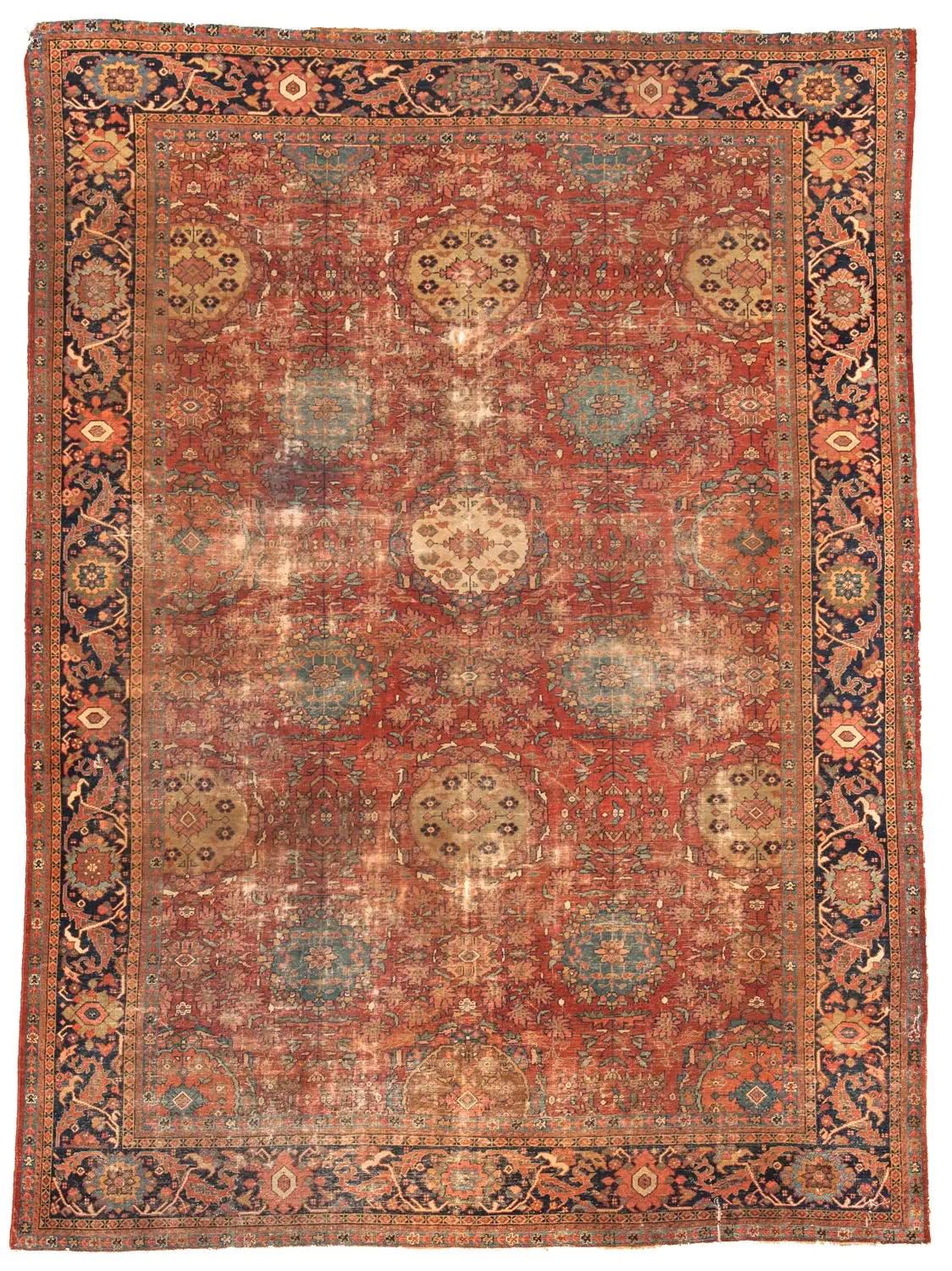
Antique Persian Mahal rug displaying a classic allover herati field.
Origins: Mahallat, Arak & the Ziegler Legacy
Mahal rugs take their name from Mahallat, a weaving district near Arak, the city once known as Sultanabad. Village weavers in this region had been producing carpets for local use since at least the 17th century, but the Mahal style as collectors know it today emerged in the second half of the 19th century, when Western demand for Persian carpets surged dramatically.[2]
In 1883, the Anglo-Swiss firm Ziegler & Co. established a manufacturing operation in Sultanabad specifically to produce carpets for European and American markets. Ziegler oversaw dyeing and design across thousands of local looms, softening traditional Persian palettes and enlarging motifs to suit Western rooms—rugs from this production are often labeled "Ziegler Mahal" and remain some of the most sought-after examples of the style.[3]
Historical significance
- Village weaving tradition in the Arak region dating to the 1600s
- Rose to international prominence during the export boom of the 1880s
- Ziegler & Co. shaped the style now known as "Ziegler Mahal"
- Held in major museum collections, including The Metropolitan Museum of Art
Close-up of hand-spun wool pile typical of antique Ziegler Mahal rugs.
Signature Design Characteristics
Mahal rugs are defined by generous, breathing-room compositions. Rather than covering the field edge to edge with dense ornament, weavers spaced palmettes, vines, and herati motifs loosely across the surface, creating a pattern that reads clearly even from across a room.
This openness, paired with naturally dyed wool that softens and deepens with age, gives Mahal rugs a quiet, architectural presence that has kept them in steady demand for well over a century.
Common design elements
- Allover herati (fish-and-rosette) diamond lattice patterns
- Palmette and vine scroll motifs
- Occasional center medallion on an open field
- Rust, madder red, camel, and ivory grounds with indigo accents
- Natural vegetable dyes that mellow gracefully over time

Allover herati field with palmette border, a hallmark of Mahal design.
Why Interior Designers Love Mahal Rugs
Mahal rugs are a go-to for designers who want the depth of an antique Persian carpet without a busy, overwhelming pattern. Their earthy, muted palettes coordinate easily with wood tones, neutral upholstery, and layered art, letting the rug anchor a room rather than compete with it.
That versatility has kept Mahal rugs in steady rotation in both traditional and contemporary interiors, from formal dining rooms to relaxed, art-filled living spaces.
Why they work so well
- Earthy palettes pair naturally with wood, stone, and neutral textiles
- Allover patterns hide wear and complement furniture placement
- Durable low-knot-count weave suited to everyday living
- Antique character adds warmth without visual clutter

Antique Mahal rug styled in a contemporary living room setting.
How to Style a Mahal Rug in Your Home
Because of their room-size scale and calm, allover patterning, Mahal rugs work especially well in spaces meant for gathering—living rooms, dining rooms, and primary bedrooms where the design can unfold across an open floor.
Placement ideas
- Living rooms: ground a seating area without overpowering it
- Dining rooms: extend at least 24 inches beyond the table on all sides
- Bedrooms: add warmth and pattern underfoot
- Home offices & libraries: bring antique character to a working space
Explore similar pieces in the Mahal Rug Collection.

Mahal rug anchoring a dining room table setting.
Are Persian Mahal Rugs Valuable?
Yes—particularly antique examples and rugs with documented Ziegler production. Mahal rugs are valued by collectors for their historical ties to the 19th-century Persian export trade, their durable hand-knotted construction, and their naturally dyed wool, which deepens in color and character with age. Larger room-size antiques and pieces with strong, even coloration tend to command the highest prices.
For collectors and design-minded buyers looking for an authentic entry point into antique Persian carpets, Mahal rugs remain one of the most livable and enduring choices available.
Sources & Further Reading
- The Metropolitan Museum of Art — Persian carpet collection and provenance records View source
- Wikipedia — Sultanabad rugs and carpets: regional history and production View source
- Encyclopaedia Iranica — Persian carpet export history and Western demand
- HALI Magazine — Scholarship and industry research on Sultanabad, Mahal, and Ziegler carpets


