

Persian Malayer rugs occupy a rare middle ground: village-woven with genuine rustic character, yet finely knotted enough to rival workshop production. Woven in and around Malayer, a city in the Hamadan province of western Iran, sitting between the two major weaving centers of Hamadan and Sarouk, these rugs blend the best of both traditions into something distinctly their own.
At Leonidas Collection, Malayer rugs are valued for their rare combination of fine village craftsmanship and understated, versatile design—pieces with genuine depth that never feel overworked.
In This Article
What Is a Persian Malayer Rug?
A Malayer rug is a hand-knotted Persian carpet woven in and around Malayer, a town in the Hamadan province of western Iran located on the road between Hamadan and Arak. Because of this location, Malayer rugs exhibit characteristics of both neighboring traditions, giving weavers a wider design vocabulary than either region alone.[1]
Structurally, Malayer rugs are known for their single-weft construction, sometimes called Sennah Baft or Hamadan weave, in which only one shot of weft passes between each row of knots. This produces a distinctive back where the cotton warps are clearly visible, and it allows for a finer, tighter weave than much of the surrounding village production.[2]
Key characteristics
- Hand-knotted wool pile on a cotton foundation
- Single-weft (Sennah Baft) construction with visible warps on the back
- Low to medium pile that sharpens motif clarity
- Fine knotting for a village rug, often rivaling workshop quality

Antique rug showing allover Herati field
Origins: Between Hamadan and Sarouk
Malayer's weaving history reaches back centuries, with the region gaining prominence as a rug-producing center during the Seljuk and Safavid dynasties. Sitting between the two major weaving areas of Hamadan and Sarouk, Malayer weavers had the opportunity to draw on characteristics of both, producing two related but distinct types of rug: one closer to Sarouk, the other closer to Hamadan.[3]
Within the Malayer region, the small village of Mishin became renowned as the area's premier weaving center during the 19th century. Carpets from this village, labeled "Mishin Malayer," were distinguished by their superior knot density, more lustrous wool, and more intricate patterning than typical regional production, and remain especially prized by collectors today.[4]
Historical significance
- Weaving tradition dating to the Seljuk and Safavid eras
- Known in the antique market since the early 19th century
- Positioned between Hamadan and Sarouk, absorbing characteristics of both
- "Mishin Malayer" designates the finest production from the region's premier weaving village

Close-up of single-weft back structure
Signature Design Characteristics
Malayer rugs draw on classical Persian design sources but render them with a distinctly geometric, abstract quality. Layouts range from diamond or hexagon-shaped medallions to allover patterns, most notably the classic Herati repeat, with borders typically built around a large rosette-and-vine main band flanked by narrower guard borders.[5]
The boteh, a teardrop or paisley-shaped motif, is one of the style's most characteristic elements, often appearing in dense, rhythmic repetition across the field. Other recurring motifs include palmettes, vine and lattice work, stylized birds, and occasionally the grape motif for which the surrounding region is known.[1]
Common design elements
- Herati (fish) allover repeat and diamond or hexagon medallion layouts
- Dense boteh (paisley) motifs
- Palmettes, vine and lattice patterns, and stylized birds
- Deep indigo, rust red, sage green, rose, ochre, and ivory grounds
- Naturally dyed wool that develops a rich patina with age

Malayer boteh motif detail
Why Interior Designers Love Malayer Rugs
Malayer rugs are a favorite for designers who want the warmth of a village-woven Persian carpet without sacrificing refinement. Their fine, tight knotting keeps patterns crisp and legible, while their rich but muted palette reads as sophisticated rather than busy.
The style's blend of curvilinear grace and rustic charm gives it genuine versatility, sitting comfortably in traditional interiors while also holding its own in more modern, layered spaces that call for texture and pattern without formality.
Why they work so well
- Fine village knotting delivers crisp, legible pattern detail
- Rich yet muted palette suits both traditional and modern interiors
- Curvilinear grace blends nomadic and urban design influences
- Antique examples offer genuine collector value at a range of sizes

Malayer rug styled in a living room setting
How to Style a Malayer Rug in Your Home
Because Malayer production historically favored smaller rugs and runners, the style is especially well suited to spaces that call for pattern and warmth in a more contained footprint.
Placement ideas
- Hallways & entryways: Malayer runners bring soul and pattern to transitional spaces
- Living rooms: layer under furniture for a grounded, collected look
- Dining rooms: extend at least 24 inches beyond the table on all sides
- Bedrooms & studies: add warmth and detail without overwhelming the room
Explore similar pieces in the Malayer Rug Collection.
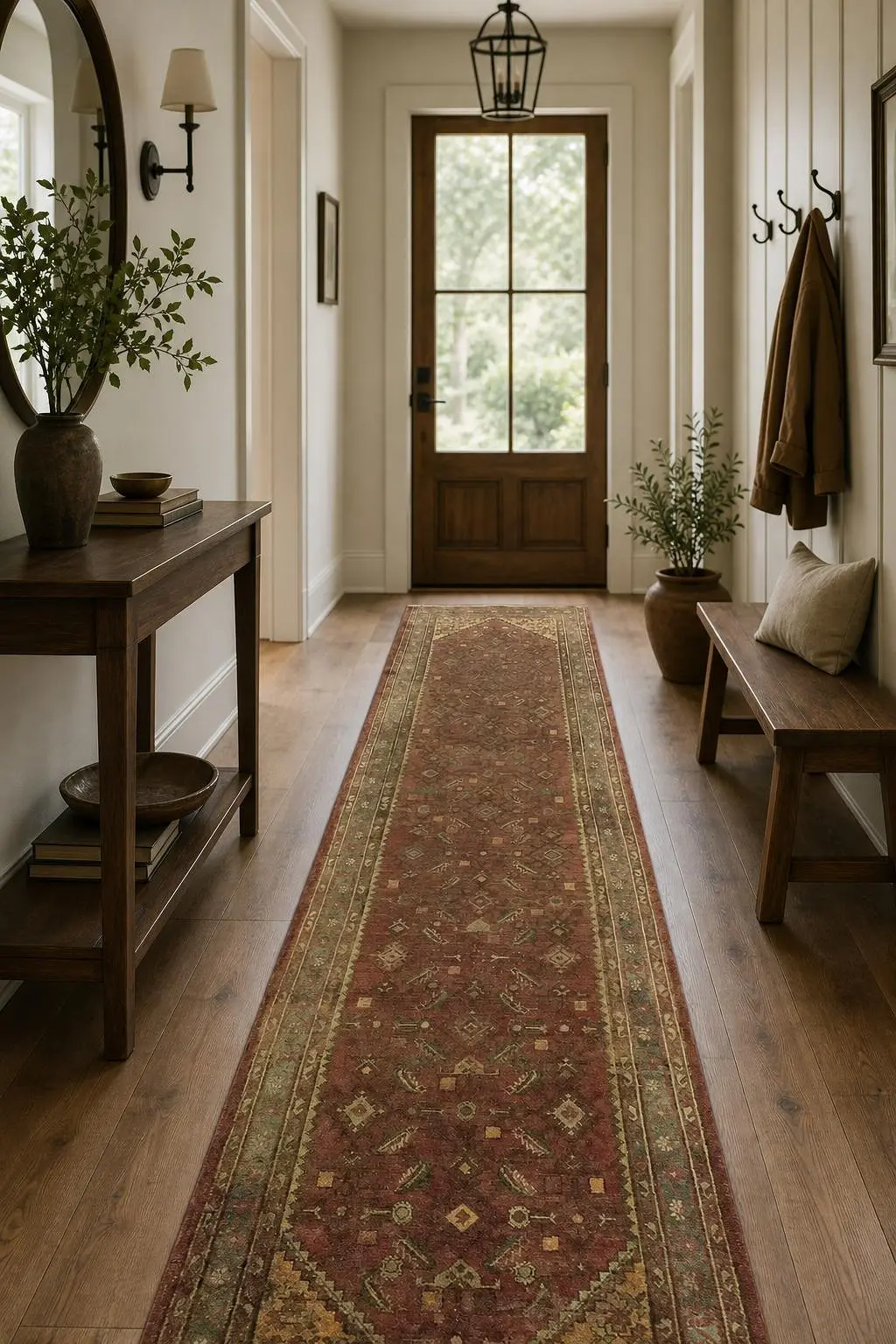
Room layout featuring a Persian Malayer rug
Are Persian Malayer Rugs Valuable?
Yes—particularly antique examples with fine, dense knotting, lustrous wool, and clearly rendered Herati or boteh patterning, and especially pieces attributed to the village of Mishin. Malayer rugs are valued by collectors for their exceptional craftsmanship among Persian village weavings, their distinctive single-weft construction, and their naturally dyed wool, which develops a rich patina over time. Because quality varies considerably across the broader Malayer region, condition and knot density matter as much as design when assessing value.
For collectors and design-minded buyers looking for a Persian rug with genuine rustic character and workshop-level craftsmanship, Malayer rugs remain one of the more rewarding categories to explore.
Malayer Rug FAQ
What makes a Malayer rug different from a Hamadan rug?
Malayer sits between the Hamadan and Sarouk weaving regions, and its rugs draw on characteristics of both. Compared to typical Hamadan village production, Malayer rugs are generally more finely knotted, with a tighter weave and more refined pattern clarity, while still retaining a village rug's rustic, geometric character.[3]
What is Sennah Baft or single-weft construction?
Sennah Baft, also called Hamadan weave, refers to a construction method where only one shot of weft passes between each row of knots, rather than the two used in many other Persian rugs. This produces a distinctive back where the cotton warps are clearly visible, and allows for a tighter, finer weave.[2]
What is a Mishin Malayer rug?
Mishin was the premier weaving village within the Malayer region during the 19th century. Rugs labeled "Mishin Malayer" featured the finest knot density, most lustrous wool, and most intricate patterning produced in the area, and they remain especially sought after by collectors today.[4]
What knot type do Malayer rugs use?
Malayer rugs are traditionally woven with the symmetrical knot, sometimes called the Turkish or Ghiordes knot, reflecting the Turkic heritage of many weavers in the region.[6]
What motifs are common in Malayer rugs?
The Herati, or fish, motif and the boteh, a teardrop or paisley-shaped design, are two of the most characteristic Malayer motifs, often repeated densely across the field. Palmettes, vine and lattice work, stylized birds, and occasionally a grape motif tied to the surrounding region also appear.
What colors are traditional in a Malayer rug?
Classic Malayer palettes are rich but generally muted: deep indigo, rust red, sage green, rose, ochre, and ivory, produced from natural dyes that age gracefully into a soft, layered patina.
What sizes do Malayer rugs typically come in?
Historic Malayer production in the 19th and 20th centuries was concentrated in smaller rugs and runners woven by individual weavers, with larger, room-size carpets typically made only on commission. Runners in particular remain one of the style's most recognizable and sought-after formats.
Are Malayer rugs a good investment?
Antique examples with fine, dense knotting and well-preserved natural color, especially pieces from the village of Mishin, are considered genuine collector's items with a track record of long-term value retention. As with any collectible textile, condition, knot density, and design clarity all factor into value.
Sources & Further Reading
- Little-Persia — Malayer rug history, origin, and design motifs View source
- WikiRug — Malayer rug construction and single-weft (Sennah Baft) structure View source
- ABC Oriental Rug & Carpet — Malayer rugs: regional influence from Sarouk and Hamadan View source
- Jewel Rugs — Malayer rugs: Mishin village and quality distinctions View source
- Matt Camron Rugs & Tapestries — Antique Malayer rug design and construction View source
- Iranopedia — Malayer rug motifs, knotting, and weaving tradition View source


