

Kazak rugs are among the boldest and most graphic of all antique tribal carpets—large-scale geometric medallions, saturated color, and a folk-art confidence that reads as strikingly modern even a century later. Woven in the highland villages of the southern Caucasus, the mountainous region between the Black and Caspian Seas, Kazak rugs take their name from a geographic area rather than a single tribe or workshop.
At Leonidas Collection, Kazak rugs are valued for their rare combination of powerful, symbol-rich design and rugged, mountain-wool durability—carpets that feel more like graphic art than decoration.
In This Article
What Is a Kazak Rug?
A Kazak rug is a hand-knotted tribal carpet named for the Kazakh district of the southern Caucasus, rather than for any single weaving culture. Historically, rugs from this area were woven by a mix of communities native to the region—including Armenian, Azerbaijani, and Georgian weavers—and pieces that can't be traced to a specific village are simply grouped together as Kazak.[1]
Kazak rugs are known for coarse, glossy mountain wool and a bold, open composition: large motifs set confidently within generous empty space, giving the style a monumental, graphic presence that's immediately distinct from the finer, more densely patterned rugs of neighboring Caucasian regions like Shirvan and Kuba.[2]
Key characteristics
- Hand-knotted with the symmetrical (Turkish) knot on a wool foundation
- Coarse, lustrous mountain wool prized for durability
- Bold, large-scale geometric motifs set in open space
- Strong, saturated color palettes, often on an abrash field

Antique rug showing bold medallions and open field
Origins: The Southern Caucasus & a Region, Not a Tribe
The Kazak weaving tradition traces to the highland villages and encampments of the southern Caucasus, an area whose weaving history stretches back centuries but whose organized export trade did not fully take shape until an established cottage industry emerged in the late 1800s.[3] As trade routes expanded, Caucasian Kazak rugs reached Europe, Asia, and eventually the Americas, earning the admiration of collectors and museums by the turn of the 20th century.[4]
Rather than one weaving center, "Kazak" covers several sub-regional groups—including Bordjalou, Karachopf, and Fachralo Kazaks—each with recognizable design tendencies, though pieces are often simply attributed to the broader Kazak category when a specific village of origin can't be confirmed.[4] Antique examples, generally woven before the Caucasus region's weaving industry shifted under Soviet administration after 1925, are considered the most historically significant and sought-after.[5]
Historical significance
- Named for the Kazakh district of the southern Caucasus, not a single ethnic group
- Organized export trade developed in the late 19th century
- Sub-regional groups include Bordjalou, Karachopf, and Fachralo Kazaks
- Pre-1925 antique examples are the most historically significant to collectors

Close-up of coarse mountain wool and knot structure
Signature Design Characteristics
Kazak design is rooted in folk-art symbolism. Motifs such as stars, wheels, ram's horns, and running-water patterns draw on a visual vocabulary with roots extending back to symbols found on regional metalwork, and weavers combined them in endless variation to create talismanic, story-rich compositions.[4]
Large central medallions, hooked diamonds, and cross motifs typically anchor the field, often scattered with smaller detached figures—stylized animals, birds, human forms, and geometric shapes—set against a strong, limited color palette, most classically magnificent reds and greens on an abrash ground. Borders are heavily patterned, favoring latch-hook motifs and reciprocal sawtooth patterns characteristic of Caucasian weaving generally.[6]
Common design elements
- Large central medallions, hooked diamonds, and cross motifs
- Folk-art symbols: stars, wheels, ram's horns, running water
- Scattered figures of animals, birds, and stylized human forms
- Bold reds, greens, and blues, often on an abrash (color-variegated) field
- Heavily patterned borders with latch-hook and sawtooth motifs

Medallion and latch-hook border detail
Why Interior Designers Love Kazak Rugs
Kazak rugs are a favorite for designers who want a rug that reads as graphic art. Their bold, open compositions and confident color pair naturally with modern, minimalist furnishings, letting the pattern breathe rather than compete with a room's other elements.
That same graphic strength also grounds more traditional or eclectic interiors, giving a space a sense of history and folk-art character without the busyness of a finely patterned city carpet.
Why they work so well
- Bold, open geometry pairs beautifully with modern and minimalist interiors
- Statement-driven color adds warmth and confidence to a room
- Durable mountain wool suited to genuine daily use
- Folk-art symbolism brings authentic tribal history underfoot
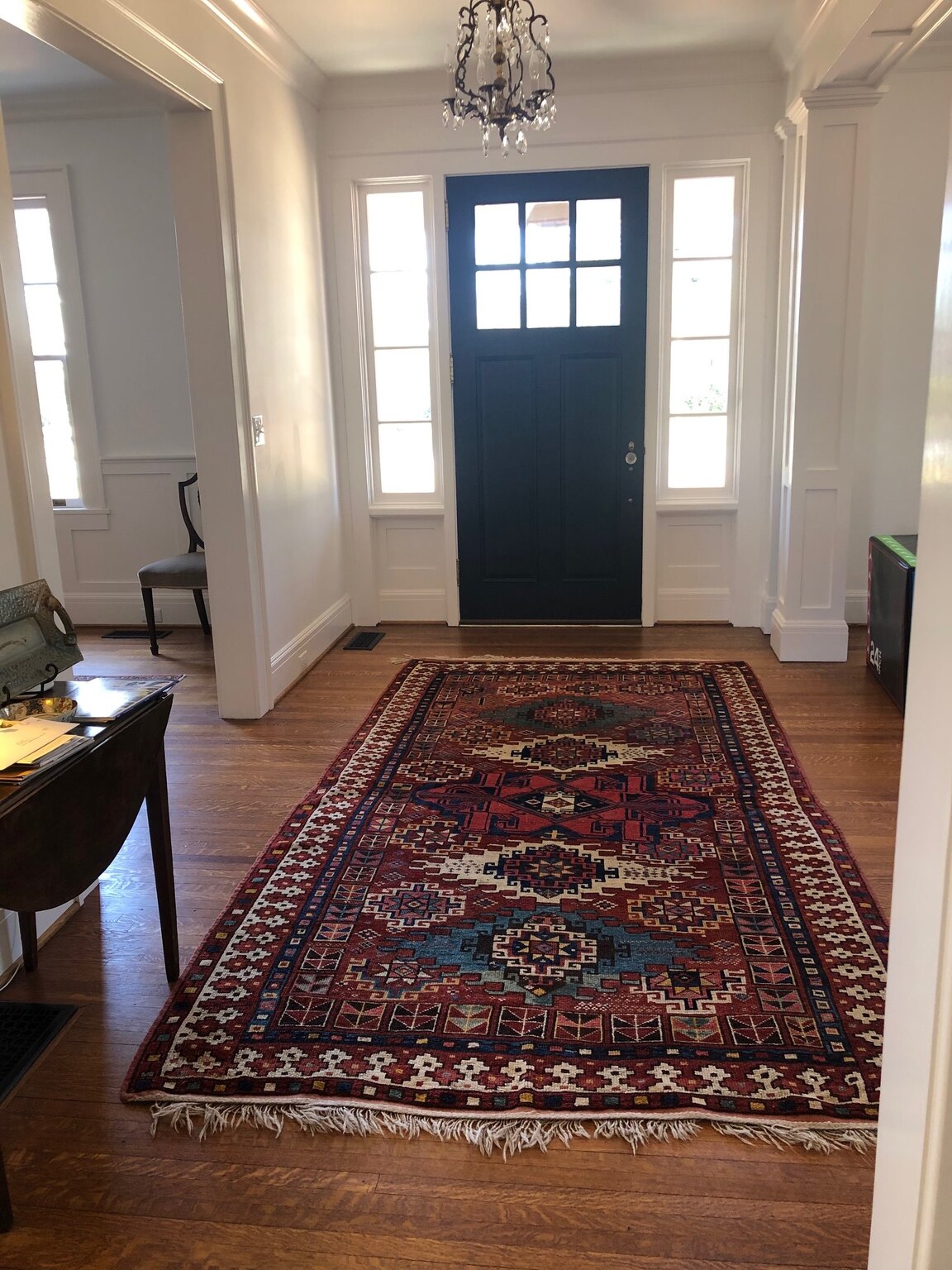
Kazak rug styled in situ in a home's entryway
How to Style a Kazak Rug in Your Home
Because of their bold scale and open composition, Kazak rugs work best where they can serve as a room's clear focal point rather than one pattern among many.
Placement ideas
- Living rooms: let the medallion anchor a seating area with graphic impact
- Entryways & hallways: durable wool handles heavy daily foot traffic
- Dining rooms: extend at least 24 inches beyond the table on all sides
- Modern & minimalist interiors: layer with wood, stone, or simple furniture to let the pattern lead
Explore similar pieces in the Kazak Rug Collection.

Kazak runner in a home's entryway
Are Kazak Rugs Valuable?
Yes—particularly antique 19th-century examples woven in the Caucasus itself, especially pieces attributable to a specific sub-region like Bordjalou or Karachopf, with strong, well-preserved natural color and coarse, lustrous wool. Antique Caucasian Kazaks are valued by collectors for their direct historical ties to the highland weaving tradition of the region, their bold folk-art symbolism, and their exceptional durability.
It's worth noting that today, most rugs sold under the Kazak name are produced outside the Caucasus, largely by Afghan and Pakistani weavers continuing the tradition with the same bold designs and techniques.[7] Consistent with our terminology, we describe these pieces as Kazak design rather than Kazak, reserving the unqualified term for rugs genuinely woven in the Caucasus region. Both categories offer real value, but they represent different collecting tiers, and knowing which one you're looking at matters as much as the design itself.
Kazak Rug FAQ
Where do Kazak rugs come from?
Traditional Kazak rugs come from the Kazakh district of the southern Caucasus, the mountainous region between the Black and Caspian Seas. The name refers to a geographic area rather than a single ethnic group—historically, weavers from several communities native to the region, including Armenian, Azerbaijani, and Georgian weavers, produced rugs now grouped under the Kazak name.[1]
Are Kazak rugs still made today, and if so, where?
Yes, though production has largely shifted outside the Caucasus. Today, most rugs sold under the Kazak name are woven in Afghanistan and Pakistan, where artisans, notably Afghan Hazara weavers, have continued the tradition using similar bold designs and techniques.[7]
What's the difference between an antique Caucasian Kazak and a "Kazak design" rug?
An antique or vintage Caucasian Kazak was genuinely woven in the Caucasus region, generally before the early 20th century. A "Kazak design" rug uses the same bold geometric patterns and color palette but is produced elsewhere, most commonly in Afghanistan or Pakistan today. Both can be beautiful, durable rugs, but they occupy different places in the collecting world, so knowing the distinction matters when evaluating a piece.
What knot type do Kazak rugs use?
Kazak rugs are traditionally woven with the symmetrical knot, sometimes called the Turkish knot, which is common across Caucasian weaving generally and contributes to the style's dense, durable structure.[6]
What colors and motifs are traditional in a Kazak rug?
Classic Kazak color palettes lean on bold, saturated reds, greens, and blues, often set against an abrash field where the color shifts subtly across the rug. Design motifs favor large central medallions, hooked diamonds, and folk-art symbols like stars, wheels, and ram's horns, along with scattered figures of animals, birds, and stylized human forms.
How is a Kazak rug different from a Shirvan or Dagestan rug?
Kazak rugs are bolder, coarser, and more graphic than other Caucasian styles like Shirvan, Kuba, or Dagestan, which tend to favor finer, more densely patterned fields. Where Shirvan and Kuba rugs project intricate detail, Kazak rugs favor larger motifs set within open space, giving them a more monumental, powerful presence.[2]
Are Kazak rugs durable enough for everyday use?
Yes. Kazak rugs are woven from strong, coarse mountain wool that ranks among the most durable of tribal rug materials, and their construction was historically built to withstand generations of daily use.
Are antique Kazak rugs a good investment?
Antique 19th-century Caucasian Kazak rugs, particularly those attributable to a recognized sub-region and in strong original condition, have a long track record of collector demand and museum interest. As with any collectible textile, authenticity, age, and condition all factor into long-term value, so confirming genuine Caucasus origin matters.
Sources & Further Reading
- ABC Oriental Rug & Carpet — Kazak rugs: regional weaving communities and history View source
- Nazmiyal Collection — Kazak rugs: bold geometry compared to Shirvan and Dagestan View source
- ABC Oriental Rug & Carpet — Kazak weaving history and cottage industry development View source
- Claremont Rug Company — Antique Caucasian Kazak rugs: history, symbolism, and sub-regional groups View source
- Carpet Wiki — Caucasus carpets: the 1925 production divide View source
- Rare Pieces — Caucasian rug construction, knot type, and symbolism View source
- Rugswise — Kazak rugs: modern production in Afghanistan and Pakistan View source


